Breaking

Showing posts with label Festival Knowledge. Show all posts

Wednesday, October 16, 2019

October 16, 2019

Albuquerque International Balloon festival


Albuquerque International Balloon festival is a hot festival that is organized in Albuquerque, New Mexico. Being the largest balloon festival in the world, this festival organizes around 500 hot air balloons each year. This festival begun in 1972 at Mexico. People and pilots from every corner of the world come to Mexico to witness this grand air party which continues for 9 days on the month of October. 


History/Traditions

 During the 50th celebrations of 770 KOB radio- a famous Mexican radio, about 13 balloons from England arrived at KOB, in New Mexico. More than 20000 spectators took part in the festivities of KOB, arriving from different parts of the United States and Mexico, along with some other countries, including England. The festival incorporated a Balloon "Roadrunner-coyote" race. In that race, Don Piccard, the winner of that 1972 race, landed nearest to the roadrunner. This way the balloon festival became famous, with the city of Albuquerque hosting the championship of "Balloon Roadrunner-Coyote" the succeeding years. Last year, a rally of balloons was organized to maintain the interests of people. A variety of people gathered at different locations of the city of view the parade of balloons.

Activities

Many artists get spectacular sightings for their paintings as a subject matter. Many group photographers, along with artists, gather and secure their corners at the park(s) of gathering of balloons. 
One of the biggest events of the festival is the Mass fiesta, where hundreds of balloons are launched into the sky at once.These balloons make different shapes in the sky, such as milk, soda cans and animals. Families that couldn't come to the spots watch these sightings from their backyards or rooftops.
Glowing balloons can also be observed at night by their propane burners. These balloons, however cannot move and remain static on the grounds.
Various challenges such as Fiesta challenge, America's gas balloon race, the flight of Nation's mass ascension, piloting skills etc. are organized, making the competition a fun filled and thrilling adventure. There is also a challenge in which hot air balloons have to land on a spot near the spectators.

This conventional festival has became a local showcase of the culture of Mexico, featuring numerous cultural exhibitions and increasing New Mexico's local business. Many camera companies also sponsored the festival, owing to the numerous pictures that are taken during the festival. These companies include Kodak and Canon.


Friday, October 11, 2019

October 11, 2019

Everything you need to know about La tomatina

This festival is celebrated every year on the last Wednesday of August from 10 am to 11 am. About one and a half million tomatoes are consumed in the midst of this beautiful tomato war. These tomatoes are sourced from a nearby town of Actrimadura, where they are cheap as well and do not taste as good. 

Everything you need to know about La tomatina
Festivities of La Tomatina

The festival began in 1945, when some youths sat in the Spanish city for a sit-in. When the police proceeded to stop them, the youth attacked the policemen by picking vegetables and fruits from the nearby vegetable shops.

Since then this festival has been celebrated and 2019 was the 70th anniversary of the festival. The rules of this tomato (tomato) war are very simple. When someone kills a tomato by throwing it at them, they have to first break the tomato and then kill it. Tearing each other's T-shirt or clothes during this time is prohibited and when someone says stop, the tomato thrower has to stop.


Spain's Tomatina Festival is very famous. Every year 20 thousand people take part in it and paint each other in tomato color. Tourists arrive from all over the world to participate in it. But due to the recession, this festival is also no longer untouched and the organizers have decided to collect at least ten euros i.e. about 910 rupees from the tourists participating in it. This decision also reinforces the fear that this event may go into private hands. Australia, Japan, Britain, Spain and USA have the highest number of people attending the La Tomatina Festival.

Since 1945, this festival is being held on last wednesday of August, during a week of festivities in Bunol.

October 11, 2019

Maha Shivratri: Origin, Tradition and Activities


Mahashivaratri is a religious festival of Hindus, which is celebrated as the birth anniversary of Lord Shiva, the principal deity of Hinduism. Chaturdashi of Krishna Paksha is celebrated in the month of Falgun, the festival of Maha Shivaratri. In georgian calendar, the month of "Falgun" marks the arrival of spring. "Falgun" ususlly falls on 13th february according to Georgian calendar. On this day, Shiva devotees and those who have faith in Shiva keep fasting and especially worship Lord Shiva.

Maha Shivratri: Origin, Tradition and Activities, Everything you need to know about Maha Shivratri
Lord Shiva

There are some beliefs related to Lord Shiva regarding Maha Shivaratri. It is believed that Lord Shiva was descended on this special day in the midnight form of "Rudra of Brahma". At the same time, it is also believed that on this day Lord Shiva opened his third eye by doing Tandava- his most ferocious dance and ended the universe with the flame of this eye. Apart from this, in many places this day is also associated with the marriage of Lord Shiva and it is believed that Lord Shiva and mother Parvati were married on this holy day.

Though there is a Shivaratri in every month, but this Shivaratri which falls on the month of Phalgun, after 13th February has a great significance, hence it is called as Maha Shivaratri. In fact, Maha Shivaratri is the festival of worship of Lord Shiva, when the religious people worship Shiva with rituals and receive his blessings. On this day a large number of devotees throng the Shiva temples, who consider themselves fortunate to worship Shiva.

On the day of Mahashivaratri, Lord Shiva is worshiped and anointed with various holy things . Lord Shiva loves cannabis so many people also offer cannabis to them. Fasting is done throughout the day and after worshiping it is done in the evening.

Legend behind Maha Shivratri


Once upon a time there lived a Bhil in the forest of Varanasi. His name was Gurudruh. He used to hunt wild animals and raise his family.  Once on Shivaratri, he went to the forest to hunt. That day he did not get any hunting all day and it became night. Then he climbed the tree by the lake thinking that if any animal comes to drink water, I will hunt. It was a wood apple tree and a "Shivling" was installed beneath it.  A deer came there. When the hunter shot an arrow at the bow to kill him, the leaves of the tree tree and the water fell on the Shivling. Thus, in the first hour of the night, she was unwittingly worshiped by her. Deer also ran away.  A little later another deer came near the lake. The hunter, seeing him, again shot an arrow at his bow. This time also in the second half of the night, the leaves and water of wood apple tree fell on the Shivling and the Shivling was worshiped. She also ran away like the deer.  After this, a deer of the same family came there, this time the same thing happened and Shivling was worshiped in the third hour. That deer also escaped. 

                                                                                                   Then the deer came to drink water there with his flock and the hunter was very happy to see everyone together and he again put an arrow on his bow, which led to the worship of Shivling again in the fourth stroke. In this way, the hunter remained hungry and thirsty throughout the day and kept awake throughout the night and the four poets inadvertently worshiped Shiva by him, thus completing the fast of Shivaratri. The effects of this fast consumed his sins and he abandoned the idea of ​​killing the deer as soon as the virtues rose. 
Then Lord Shankar appeared from the Shivling and gave a boon to the hunter. That time, during the ear of Lord Rama would come to your house and befriend you. You will also get salvation. Thus, Lord Shiva gave salvation to the hunter due to the unknowingly fasted during Shivaratri.
October 11, 2019

The significance of Good Friday


According to Christianity, Jesus Christ was the son of God. Jesus is also called Jesus. He was hanged on the cross on the day of "Good Friday". On this day, the Lord Jesus, who instills love and faith in people throughout his life, is remembered and his teachings are recited. On Good Friday, devotees pledge to walk on the path of love, truth and faith. Many people mourn on this day by wearing black clothes.

The significance of Good friday, Everything you need to know about good friday
The significance of Good friday


Good Friday


The date of Good Friday changes every year on both Julian and Georgian calendars.  On Good Friday, Christ was hung on the cross. He was accused of hypocrisy and calling himself the son of God. Good Friday is a hobby day, but because Jesus Christ died on this day, it is called "Good" Friday.

Good Friday has special significance for Christians. On this day Jesus sacrificed his life on the cross. Although he was innocent, he was hanged on the cross. Before he was being crucified, he quoted "He did not accuse those who punished, rather he pardoned them, because they do not know what they are doing."

Why Jesus was Crucified? 

When Jesus was young, he wandered around and gave the message of humanity and peace to the people. He called people who spread superstition in the name of religion an enemy of mankind. Distraught with his messages, the piety sentenced him to death by accusing him of contempt of religion. Two thousand years ago, Jesus was given the death penalty because Jesus was teaching people to remove the darkness of injustice and gross luxury and ignorance. 
At that time, rabbinic rabbis (religious leaders) of the Jews strongly opposed Jesus. He did not find anything special in Jesus like the Messiah. He loved his rituals. It was a huge sin for him to call himself the son of God. So he complained to the then Roman governor Pilate. The Romans always feared the Jewish Revolution, so to please the hardliners, Pilate gave Jesus cruel punishment on the cross.
Jesus was tortured in many ways. A crown of thorns was placed on Jesus' head. After this, Jesus lifted the cross on his shoulder and took it to a place called Golgotha or Calvary, where he was crucified. The day Jesus was crucified was Friday. Jesus called out to God in a loud voice - 'Father, I hand over my soul to you.' He gave up his life after uttering such words. Jesus was in favor of change. He did not tie the limits of human love, but by his sacrifice he described him as autistic and beyond selfishness.

What happens on Good Friday?

On Good Friday, followers of Christianity go to church and remember the Lord Jesus. The devotees remember the suffering suffered by the Lord Jesus on the cross for three hours. Wearing black clothes at night time, the devotees take the footsteps, mourning while taking the image of Jesus with them.
Good Friday is a day of atonement and prayer, so bells are not played in the churches on this day, but instead a wooden knock is made. People remember God by kissing the cross symbolizing Jesus Christ. On Good Friday, Christians around the world donating to charity and promoting social work in the church.
October 11, 2019

Ganesh Chaturthi: Origin, Tradition and Activities

Ganesha Chaturthi, celebrated every year during the months of August/September,  is of the biggest festivals of Hindu religion, According to the stories mentioned in the "Ganesha Purana", on this day, Lord Ganesha, the son of Lord Shiva and Goddess Parvati, who was able to remove all obstacles, was born.

Ganesh Chaturthi: Origin, Tradition and Activities, Everything you need to know about Ganesha Chaturthi
Ganesh Chaturthi: Origin, Tradition and Activities


Ganesha Chaturthi Festival


This mega-festival, celebrated on the birthday of Lord Vinayaka, is celebrated in a grand manner in all the states of India including Maharashtra. It is unknown when did the festival started. However, the festival became a major one after the Mughal-Maratha wars in South-west India during 1600 C.E.

Ganesha Chaturthi Celebrations

Two to three months before the festival, skilled craftsmen start making beautiful clay idols of Lord Ganesha. Lord Ganesha is depicted in various positions in these sculptures. On Ganesha Chaturthi, these idols are brought home with great enthusiasm and are kept and worshiped at home for the next 10 days. Beautiful temporary sheds are also made with huge idols of Ganesha at many places. 

Priest in each circle performs the four main sacred rituals - In the first phase, the utterance of the souls in the idols is done by the chanting of sacred mantras. There are 16 ways of paying homage to Lord Ganesha after this ritual. Then prayers  is done so that the idol can be sent from one place to another. The last ritual is that of Ganapati immersion, which occurs on the last day of the festival. People submerge the Ganpati idols in the water bodies, praying Lord Ganesha to come again next year.

The legends behind Ganesha Chaturthi

According to the legends, before taking bath, Maa Parvati produced a beautiful child from her scum and named it Ganesha. Then, making him his gatekeeper, went to bathe, ordering him to guard the door. After a while Lord Shiva came and wanted to enter the door, then Ganesha stopped him from going inside. Lord Shiva got angry on this and cut off Ganesha's head with his trident and went inside the door. When mother Parvati saw the severed head of son Ganesha, she became very angry. Then all the gods including Brahma, Vishnu, praised him and pacified them and requested Lord Shiva to bring the child Ganesha alive. Lard Shiva, accepting his request, revived him by attaching an elephant's head to Shri Ganesh's torso. 

Why watching moon is prohibited in Ganesh Chaturthi?

According to the Purana, a person who sees the moon on Ganesha Chaturthi becomes a victim of "Mithya Dosham" or Illusion stigma. According to mythological beliefs, Lord Krishna had to bear the false charge of stealing the precious jewel Syamantaka to see the moon on the day of Bhadrapada Shukla Chaturthi. Lord Narada told Lord Krishna that Lord Ganesha cursed Chandra (Moon) that whoever would see the Moon on this day would be cursed with illusion stigma and humiliated in society.

Wednesday, October 9, 2019

October 09, 2019

Songkran: The Water Festival- All you need to know

Water festival is a fun filled festival that is celebrated in various south Asian countries such as Cambodia, Thailand, Myanmar etc. It is also celebrated by the Dai Community of China. This festival is celebrated on the occasion of Thai New year, and is generally celebrated during 13th to 15th April according to the Georgian calendar. Songkram was made famous as "Water festival" in west because of the custom of the festival of splashing or pouring water on each other. This was done as a cleansing ritual to welcome the new year, but eventually it turned into a fun and excitement filled with festivities for the people of South Asia. 

Songkram is a Sanskrit word meaning passage of Sun from one Zodiac sign to another, or specifically, when the sun enters the zodiac sign of Aries. It is believed that during the water festival, older things must be thrown away, otherwise it would bring bad luck to the owner. The act of pondering water brings good luck and wishes. 

Songkran: The Water Festival- All you need to know, Water festival-origin, activities and tradition
Songkran: The Water Festival- All you need to know


Origin and History

 The Songkran is very similar to the Indian Holi festival, Chinese Ching Ming, Christian Easter and some other festivals. In Thailand, people celebrated new year by sprinkling water over each other, signifying changes and goodness that new year might bring to their lives, and also cleaning up all the old evils, and prejudice from the minds, bringing happiness and goodness in the lives.

Traditions and Activities

The dates of the festival were traditionally chosen in olden times, according to their religious calendar, falling in the month of April. The month of April was also associated with heat and summer in South east Asia. So, people stared playing with water during the celebrations of Songkram. Along with water, colorful chalk powder is also used with water, which make the celebrations almost identical to Holi festival in India. People also use blessed water to clean the images and idols of Lord Buddha. 

Along with peaceful plays, the custom of water fights is also prevalent and common. Thais walk down the streets with water guns, splash balls or containers of water and splash the water on whoever they encounter. 

Although currency exchanges remain open, banks and other institutions remain closed during the festival. This festivals has different names in different countries, such as Peemai in Laos, Songkram of Peemai in Thailand, Thingyan in Myanmar etc.. Traditional dance, singing and cultural shows are performed together along with the festival. Religious activities are carried out in both "Pagoda" and "Monastries". Young pay respect to elders and get blessings from them during the festival.


Songkran: The Water Festival- All you need to know

Tuesday, October 8, 2019

October 08, 2019

Harbin Ice and Snow Sculpture Festival

Harbin ice and snow sculptures festival is an International annual festival of all the cold things in Harbin, China. This festival demonstrates various ice sculptures created by various participants came from all around the world. Some of these sculptures such as Niagra falls sculpture even hold the Guinness world record for the largest sculpture ever, with more than 250 meters long  and about 8.5 meters high. This festival officially starts from January 5 each year and lasts for about a month. This festival was first organized in 1963. 

The festival is organized into different themes each year, such as "Olympic  theme", "Prosperous China", "The Great wall of China", "Pyramids", "Castles", "Terra-Cotta warriors" and many other themes in the past years. There are also various activities held during the festivals for tourists, such as ice skating, skiing, and winter swimming etc.. The exhibition is organized in various parks and gardens, the main ones being Sun Island and Ice and Snow world. These parks are rebuild into newly designed ice buildings displaying the talents of various artists from around the world.

Harbin Ice and Snow Sculpture Festival, Everything you need to know about ice festival
Harbin Ice and Snow Sculpture Festival


Origin and History

This festival originated in the Harbin's traditional ice show and garden party, during the winter season, that originated in 1963. However, due to Chinese cultural revolution, the festival was interrupted a number of times. However, during 1985, it was resumed once again at Zhaolin Park, where it was announced to be happening in 1985. This festival, in 2001, merged with Heilongjiang's International Ski festival, and became more famous since.  

The ice festival is a competitive event, with competitors coming from all over the world- United States, Japan, Sri Lanka, Canada, France etc.. building one of the best ice statues ever, making the competition more harder and tougher. At nighttime, these sculptures are  illuminated with a wide spectrum of light showers, making the festival an awesome light and snow show for the spectators. The location of Harbin makes is at southern Siberia, where the average winter temperature lying around -16.6 degree Celsius. Annual low temperatures of around -30 degrees are also not uncommon. 
Fireworks light up the sky on various evenings, creating a beautiful display of lights and colors on land as well as on skies. Various slides, archery events, sports for tourists are also organized.

Harbin Ice and Snow Sculpture Festival

Monday, October 7, 2019

October 07, 2019

The Carnevale celebration in Italy

Carnivale of Italy is one of the most colorful celebrations around the world. This world famous carnival is famous for it's decorative and creative masks. This festival is also celebrated internationally. Carnival of New Orleans, Rio, Notting hill are some of the examples. This festival continues upto the Christian festival of Lent, fourty days before Easter.

The Carnevale celebration in Italy, Everything you need to know about carnivale in Italy
The Carnevale celebration in Italy

Origin and History

It is widely believed that the carnival of Venice started with the victory of Venice republic against the Patriarch Ulrich II won traven of Aquileia in the year 1162. In the celebration of this grand victory, people started dancing and enjoying the celebrations, and gathered at San Marco Square, also known toady as "Pizza San Marco". Some experts believe that the carnivale originated from the Latin word "carnem levare", meaning taking away meat. This name was adopted because carnivale ends with Lent, the day of fasting, in which people stopped eating meat. It was the day of Ash Wednesday.

Although the carnivale history is not a simple one, this festival was believed to be influenced by various practices of Greek and Roman cultures. Some people also believed the festival accounted for the oncoming of spring, where people would paint their faces and bodies for traditional chanting and dancing in unison. 

During the eighteenth century, the baroque carnival, which formed a prestigious image of Venice in the world, became increasingly popular. However, masks, along with the festival became forbidden after 1797 during the rule of Fransis II, an Austrian Emperor. he rebirth of the festival along with old masquerade tradition took place in 1979.  Since 1979, the festival became immensely popular, attracting more than 3 million visitors every year to Venice for the carnival.

The History of Carnivale Masks

Due to class hierarchies in Europe, some of the Veterans used to cover their faces with mystical masques, which was considered as an unique veteran response to the class hierarchy. There were evidences of these masks being used during the 13th century. Since the laws allowed anyone to come to the carnival in any dress, or style, the Veterans visited the carnival with their unique masques. This lead to gain in interests of people visiting the carnival, and masquerades became "a thing to observe". Today, these masques are much more decorated. 

Along with masques, Carnivale is also famous for it's food, feasting and dancing. Various dances are organized in the carnival attracting several visitors. Unique Venetian food is another "mandatory" to be done while in the carnival.

The Carnevale celebration in Italy

Sunday, October 6, 2019

October 06, 2019

The Octoberfest: A festival of fun, energy and liveliness

Oktoberfest is the world's largest folk festival originated in Germany. It is also the world's largest Volksfest(beer festival). It extends for around 16-18 days, asserts so much of energy and enthusiasm that you might never forget for the rest of your life. Thousands of people gather in the carnival, enjoying music, food, rides, adventures and parades. During the festival, a large quantity of Oktoberfest beer is consumed. People also take those beers in their homes, celebrating the festival to full extent. Visitors also enjoy numerous attractions, including games, amusement rides and sidestalls.


The Octoberfest: A festival of fun, energy and liveliness, Everything you need to know about octoberfest
The Octoberfest: A festival of fun, energy and liveliness

Origin and History

The history of this festival takes us to the times of Ancient German Empires. During 1700's-1800's, Crown prince Ludwig married Princess Therese on October 12th, 1810. People from all over the city off Munich were invited to attend the festivities of the royal event. Horse races were organized for Prince and Princesses and the attendees for their entertainment. A fairground was organized outside the city in a naturally suitable location. Over 40000 spectators attended the fairground, enjoying the spectacular horse race with the Prince and princess.
There were various beers too, from old Traiteurs to Bordeaux, each available to the public, along with lots of food options, taking the celebration to perfection. Since then, the king organized the celebrations every year, creating the festival among the masses. The festival spread out to neighboring cities and states, and soon, it became world famous as one of the biggest beer festivals around the globe. 

Some highlights and customs of the Octoberfest

Beer Barrels

After the parades, the restaurants and shops are filled with people performing the famous "beer barrel tapping" ceremony. This has to be performed at exactly 12 o'clock. Once the barrel is tapped, the Oktoberfest is considered "open". Some of the famous beers brewed in the city of Munich are:
Paulander
Lowenbrau
Spatenbrau
These beers are in the "club of Munich brewers", served in Munich Oktoberfest festival.

Parades

Among the parades, the traditional costume parade is the most honorable. It took place in 1835 for the first time. Since 1835, is has become one of the world's largest parades of it's kind.


October 06, 2019

Lantern Festival or Chinese new Year: History and Traditions and Origins

Lantern Festival is a Chinese festival mostly prevalent in South-East Asia, in the countries of China, Taiwan, Malaysia, Indonesia etc. Usually celebrated between the months of February-March, the date of this festival is set on the 15th day of the first month on the Chinese lunar calendar. This festival is also known as Spring festival, it marks the final day of Chinese new year celebrations. It is celebrated on the first full moon night of the new year according to Chinese calendar.

Lantern Festival or Chinese new Year: History and Traditions and Origins, Everything you need to know about lantern festival
Lantern Festival or Chinese new Year: History and Traditions and Origins 


Origin and History

The history of the Lantern Festival dates back as far as 2000 years ago. There are many widely believed origins of this festival. The first origin was, as believed, during the reign of the second Emperor of Chinese Han dynasty, Emperor Ming, who noticed Buddhist monks lightning the temples with lanterns and candles on the fifteenth day of the first lunar month. Emperor Ming turned this tradition of lighting lanterns into a festival, by ordering all the households, workplaces, and buildings to lighten up with lanterns on that day. 

Another legend states that the festival originated as a celebration of "declining darkness of winter season". The cold winters, especially in China, bought about loneliness in streets, declining markets and darkness. This festival marked the decline of winter darkness and brought about celebrations and happiness in people's lives. 

Wudi and Han dynasties declared this day as one of the biggest festivals of China. Sooner, it spread to other countries such as Taiwan, Indonesia etc.. Nowadays, it is celebrated in various countries, even far off from China throughout the world. 

Customs and Traditions

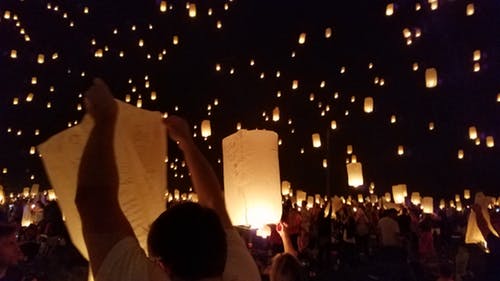
In countries such as Malaysia or Indonesia, Lantern festival is known as "Chap Goh Meh", meaning 15th night. In Japan, it is known as 小正月 (Koshogatsu), or New year. People celebrate this festival by decorating their houses with various lanterns. Lanterns of various textures, colors and shapes such as dragons, long kites, traditional globes, and goats fill up the cities and the skies. People gather at various places to illuminate the sky with thousands of lights at once displaying a beautiful amalgam of joy, hopes and liveliness. People also enjoy eating various dishes such as Tangyuan or Yuanxiao, a round sweet mouth watering delight. 

Lantern Festival or Chinese new Year: History and Traditions and Origins, Everything you need to know about lantern festival
Lantern Festival or Chinese new Year: History and Traditions and Origins 

Today, a display of lanterns is still a major event in this festival. Various parks and gardens look like oceans of colorful lanterns. In various metropolitan cities like Shanghai or Hangzhou have adopted neon lanterns, which are seen along with wooden or paper lanterns. People in countries such as India, Pakistan, USA and various other countries of western world also celebrate the Lantern festival with excitement and delight. This festival conveys the messages of love, family reunion, prosperity, peace, happiness and abundant harvest. Lantern quizzes and riddles are also an important part of this festival.

Sunday, September 29, 2019

September 29, 2019

Dussehra in India

Dussehra, or "Vijayadashmi" is an Indian festival which is celebrated as a symbol of victory of good over evil. It is celebrated during the months of September or October. According to Indian calendars, the day is observed during the months of "Ashwin" or "Kartik". 


Dussehra in India, Everything about Dussehra festival of India
Dussehra in India

History of Dussehra

According to Indian mythology, in the epic of Ramayana, about 1000 years back, Lord Rama, during his long and fierce battle with Rawana, a highly knowledgeable and skilled demon, killed Rawana on this day, and created a history. It is believed that no one had enough fighting skills and knowledge that even noble Gods of heaven feared to battle with him. He was a powerful demon king disturbing Priests or "Rishis". Lord Rama killed Rawana on this day, and ends the evil rule, establishing the era of "Satyug", or "The golden age".  Lord Rama established peace in the world, and started coming back to his own country. It took him 21 days by foot to return to his palace, and therefore, Diwali-the festival of lights is celebrated 20 days, actually one day ago, symbolizing the homecoming of Lord. The palace was decorated with candles and lights like never before, and so people clean their homes and decorate them with lights to celebrate Diwali.

Dussehra Celebrations

In India, Dussehra is celebrated in various ways in different states in India. People celebrate Dussehra in different manners, although the excitement for the festival throughout the country remains the same. In various regions throughout India, the Dussehra is celebrated as follows:

1. Northern India

  In Northern India, particularly Punjab, Delhi, Uttar Pradesh etc.. people organize "Ramlila", the play of Ramayana continuing for nine days, starting from first day of Navratri. In the tenth day, the occasion of Dussehra itself, a big fair is organized. The individuals acting as Rama and Sita pass through the croud. A giant mannequin of Rawana is often seen in the fairs, and Rama uses his bow to fire the giant mannequin.

2. Southern India

In south India, the celebrations range from worshiping Durga, fairs in temples and forts, feasts and display of colorful "Golu", an idol or Rama. In south India, Mysore has been a major celebration center of Dussehra/ Vijaya Dashmi.

3. East India

In Eastern India, Dussehra is known as "Bijoya Doshmi", the bengali translation of Vijaya Dashmi. Here, the tenth day of Durga Puja is marked by a great procession of carrying the idol of Durga to the rivers or oceans for a solemn goodbye to Durga. It is an emotional day for the people of north-east. 


____________________